

Saturday, June 2, 2012


Ready to Go...More or Less
I'm packed. Have my gear, helmet, shoes, gloves, water bottles, everything. I cleaned my chain thoroughly, reinstalled it, lubed it, and tested in for about 200 miles. I'm good to go, right? Of course, the gremlins come out at night.
This morning, I had a few minutes to kill after I woke up, and decided to clean and lube my chain. I clean it. I lube it -- with the heavier oil since it might rain, and then try to run through the gears. What happens? I can't shift into the high gears!! GAH. The rear derailleur won't budge from the middle cog.
Videos make derailleur adjustment seem doable, but without a work stand, the process would take me a few hours! Who's freaking out? Me?
Anyway, all the local bike shops don't open until 10:00 a.m., so I can't get someone to look at it right now, and my ride is due in 15 minutes anyway. Not sweating...there are bike techs at the rest stops, right?
Still, it would be nice to have my high gears for tomorrow morning!! As it turns out, there will be a bike technician (sponsored by Cannondale) at the Orientation day.
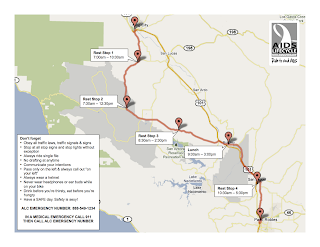
Here's a map of the orientation day set up.
Now I just want to leave and hope that the line for the technician is not too long so that there's time after orientation to get to Mr. S Leather for some last minute shopping.
This morning, I had a few minutes to kill after I woke up, and decided to clean and lube my chain. I clean it. I lube it -- with the heavier oil since it might rain, and then try to run through the gears. What happens? I can't shift into the high gears!! GAH. The rear derailleur won't budge from the middle cog.
Videos make derailleur adjustment seem doable, but without a work stand, the process would take me a few hours! Who's freaking out? Me?
Anyway, all the local bike shops don't open until 10:00 a.m., so I can't get someone to look at it right now, and my ride is due in 15 minutes anyway. Not sweating...there are bike techs at the rest stops, right?
Still, it would be nice to have my high gears for tomorrow morning!! As it turns out, there will be a bike technician (sponsored by Cannondale) at the Orientation day.
Here's a map of the orientation day set up.
Now I just want to leave and hope that the line for the technician is not too long so that there's time after orientation to get to Mr. S Leather for some last minute shopping.
Wednesday, May 30, 2012
On-the-ride Time Management
This was such a great little essay on how to manage time on the ride, that I'm sharing it (currently without permission) from Samantha:
If you've joined any of our Sacramento or Vacaville Training Rides, then you know I am not a very fast rider or a strong climber. I'm typically the last one on a route to roll in. But I do roll in. Last year in ALC I managed to ride every mile and finish every single day. How did I do this if I'm so much slower than everybody else? Four things:
If you are a rider who doesn't routinely average 14-15 mph on a training ride, then stay focused and think hard about #4. Getting in and out of rest stops is a key component to riding every mile. I know we get tired and sometimes the miles ahead can feel daunting - and trust me, it doesn't matter how fast or fit you are, by the last rest stop on day 3 it will be difficult to climb back on that bike.
- I trained sensibly and methodically.
- I stayed focused on just riding rest stop to rest stop.
- I routinely checked my bike for possible mechanical issues.
- I managed my time and got in and out of rest stops quickly!
Rest stops always feature the same things: bike parking, porta-potties, food station, water station, and medical station. Rest stop 4 usually features entertainment. Usually there's nowhere to sit down at any of the stops unless it's the ground. And don't sit down anyways unless you really need to stretch something, because it only makes it harder to get back on the bike. You can sit for a little bit at lunch. The key is to keep moving and be quick about it.
Start thinking of your rest stop routine now. Start practicing on the training rides you have left!
So we are nearing the end of training and the big Day 1 is looming. Use the training time you have left to work on your habits, get in a rest stop groove, and work on your time management plan or whatever plan you think you are going to need for whatever is your definition of a successful ALC.
- When you roll into Rest Stop 3 on ALC think about how many miles you have left until the end of the day and how much time you have. Can you put some extra food in your jersey, so all you need at Rest Stop 4 is water? As you approach rest stop 4 and you still have one full bottle of water left, do you really need to stop at all? Yes, Rest Stop 4 is fun and they usually put on a show. Before you go to ALC decide what you want to do - do you want stop and see the show every day or do you want to ride every mile. If you are having a slow day and you want to ride every mile, then plan ahead at rest stop 3. Agreeing with yourself right now what you want to get out of the ride every day gives you one less thing to think about when you are on the ride. It is totally okay to not ride every mile. We are there for the cause, right? It's also okay to ride every mile even if it means you skip some of the fun stuff. This is your ride! It's not a race. But a good time management plan can really help you.
- Roll into the rest stop. Park your bike. Do what you need to do. Get back on the bike and go. It's that simple.
- On Day 3 when we ride through the town of Bradley and they have the BBQ lunch, take a look at that line. Check your time. Think about how there's really no shade to stand in. Do you want to stand in that line for potentially an hour in the sun, when you can quickly make a donation to the school and go grab an ALC lunch? Maybe...maybe not? But think hard about it. I chose to stand in that line and for me personally it was a mistake. That cheeseburger was the best thing I had tasted in days, but standing around for that long took it's toll on me. This year, I'll be taking the ALC lunch and while I eat it, I'll lovingly think of Perry who probably devoured two cheeseburgers an hour before I even arrived in Bradley. I'll pretend my turkey sandwich is a cheeseburger and then quickly get on the bike and get moving again.
- Riding on the ride with a boyfriend/girlfriend/partner/friend/someone? Have a conversation right now and come to an agreement of how you are going to ride together each day. Are you going to wait for each other? If one of you is going to need to SAG, is there already an agreement the other one keeps riding? All of this plays into my time management principles as well. Don't waste time on the side of the road figuring out what the other is going to do. It also will keep hurt feelings at bay. I'm telling you - Work it out now people!!
Lastly, while on the ride be prepared to have the following constantly shouted at you through a megaphone:
"RIDERS! You need to get back on your bike and move to the next rest stop! RIDERS! Get moving. RIDERS! Get on your bike and go!"
Tuesday, May 29, 2012
Day 6
OK, I've lived in both Northern and Southern California — Oakland, Berkeley, San Francisco, Cathedral City — but reviewing the route has really made me realize how vast California is, and how little I know about it! Day 6 goes from Lompoc to Ventura, and I have never really visited any of the places on the route:
 I have been to Santa Barbara, and it is a stunning city, but only on a drive-through while on a road trip. Good to know for future visits: Santa Barbara has an extensive set of bike trails; you can order a bike map on line for free, or download it in two parts — northern and southern Santa Barbara County.

Day 6 seems to be mostly on the coast! Coastal views are every rider's dream, but possibly also every rider's bane, if coastal breezes cause headwinds! This is what the ALC has to say about Day 6:
Lompoc to Ventura
Day 6 begins on one of the prettiest roads on the entire route. You will pedal through vast expansive ranchlands with wildflower-covered hills on both sides! As you ride toward the coast through the gorgeous Gaviota Pass, you will be on US101. This is a well-travelled freeway and caution should be practiced at all times along this portion of the route. After lunch, you will pass through the heart of Santa Barbara, Montecito and Carpinteria, and on into Ventura, where we camp at San Buenaventura State Beach. Highlight of the day: Day 6 is your best bet for dolphin sightings!! Cast an eye to the sea and perhaps you will glimpse those playful creatures jumping in and out of the water as they frolic just off the coast.

River Park
Sweeney Rd. & Hwy 246, Lompoc, 93436

San Buenaventura State Beach
901 San Pedro St., Ventura, 93001


Day 6 seems to be mostly on the coast! Coastal views are every rider's dream, but possibly also every rider's bane, if coastal breezes cause headwinds! This is what the ALC has to say about Day 6:
Lompoc to Ventura
Day 6 begins on one of the prettiest roads on the entire route. You will pedal through vast expansive ranchlands with wildflower-covered hills on both sides! As you ride toward the coast through the gorgeous Gaviota Pass, you will be on US101. This is a well-travelled freeway and caution should be practiced at all times along this portion of the route. After lunch, you will pass through the heart of Santa Barbara, Montecito and Carpinteria, and on into Ventura, where we camp at San Buenaventura State Beach. Highlight of the day: Day 6 is your best bet for dolphin sightings!! Cast an eye to the sea and perhaps you will glimpse those playful creatures jumping in and out of the water as they frolic just off the coast.
River Park
Sweeney Rd. & Hwy 246, Lompoc, 93436
San Buenaventura State Beach
901 San Pedro St., Ventura, 93001
83.3 Miles
ALC Packing List
Here's a list of the things I'm bringing, need to get, and am considering bringing.
Ready to Go:
- My bike and Little Trunk — Two Tubes, Pump, Tiny tools, Tire Irons.
- Tool Kit — lube, wrench, extra cleats.
- Sleeping Bag — 30 deg. rated, inexpensive but lightweight and compressable bag.
- Sleeping Mat — expensive "Thermarest" 3 lbs.
- Six Ziplocks With Each Day's Kit — bibs, jersey, and socks. (Will have to double up one day.)
- Three Pair of Gloves — zip locked; seems like enough.
- Sleeves and Leggings — zip locked.
- Helmet.
- Cleat covers.
- Riding Sunglasses.
- Garmin, Heartrate Monitor, and Charger.
- Recharging Unit for Garmin (and iPhone) — Not solar, 'cause I don't want it on my bike all day.
- Camp shoes — Not sure my toe'd sandals are sufficient; still considering my options.
- Socks — I guess its going to be cold.
- Underwear — 5 pair, I guess.
- T-shirts — 5.
- Sweater.
- Shorts and pants — one of each.
- Regular Sunglasses.
- Toiletry Bag — toothpaste, toothbrusth, face wash, lotion, deodorant.
- Preride Ziplock — sunscreen, vaseline (sorry, butt-butter is way too expensive), salt pills, anti-fatigue pills (skeptical about these).
- Camp Ziplock — toilet paper, nose strips, nasal spray, "personal" lubricant and related items.
- iPhone, headphones, and charger.
- Water bottle.
- Camp Cap — got a very expensive folding one from REI.
- Jacket — But which one? Will my bike jacket do?
- Camp Pillow — looks so insubstantial when you unpack it, but gets comfy once it puffs up.
- Pharmaceuticals — ibuprophen, prilosec, temazepam, allergy pills.
- Flashlight.
Still Need to Get:
- Camp Sheet — some will increase the warmth rating of your bag by 20 deg, but cost as much as my bag.
- Warm Gloves.
- Toilet Wipes.
- Dryer Sheets — to keep dirty clothes from stinking.
Deciding if I Should Bring:
- Novel.
- Camp Cup — thinking I'm not going to want to wash it.
- Camera — too heavy and wouldn't want to damage it.
- iPad — would be cool to take some panoramas, but guessing no, won't have enough charging power.
- Playing Cards.
- Teddy Bear.
Friday, May 18, 2012
Sacramento, a Bike-friendly City
One of the best things about Sacramento is that bike riding here is easy and relatively safe. First, there is the 32+ mile American River Bike Trail (apparently also known as the Jedediah Smith Trail *snicker*) which connects to other trails and connects Davis to Folsom, through Sacramento:
 Another reason is that the city is flat, and so easy for just about any level of bicyclist to access on two, unpowered wheels. Of course that means that the bike trail is largely flat, too, but the Folsom ends takes you right to the foothills of Placer County and the beginning of some great, well paved, but sparsely traveled hills to let loose on. In fact a ride to Auburn is easy from Folsom.
Finally, there is May is Bike Month. I'm not entirely sure what group organized this event or administers it, but so far in May Sacramento area bike riders have logged over 800,000 miles riding their bikes:


 |
| A bit of Placer County |
MILLION MILE CHALLENGE
2012 Total Miles: 878,204
Total Registered Cyclists: 8,354
Total Miles Pledged: 1,559,271
So get out of your car, and get on the road!
Monday, May 14, 2012
Day Five, Red Dress Day, and Some Pics
Day five takes us through the city of Santa Maria, aka BBQ capitol of California*, through the Vandenberg Air Force Base, and into Lompoc, apparently the flower seed capitol of the world (take that Santa Maria). The route is only 42 miles with minimal climbing. The maximum elevation is only about 800 feet and the route closes at 3:00 p.m.
Which all explains why this day is Red Dress day! Everyone will be dressing in costume and wearing silly non-bike friendly garments. I have a couple ideas, but I still need to go shopping for it! I'm expecting that this will be a very fun night indeed! And no, I will not be wearing a dress.
 Here are a couple team pictures from this weekend's ride, 5/12/12 from the Temple Cafe in Sacramento to Auburn up Auburn-Folsom Road and back:


*Santa Maria is perhaps most notable for an excellent variety of barbecued meat. The tri-tip steak has its roots in Santa Maria[citation needed]. Tri-tip is a cut of beef from the bottom sirloin. It is a small triangular muscle, usually 1.5 to 2.5 lb (680 to 1,100 g) per side of beef. In the United States, this cut was typically used for ground beef or sliced into steaks until the late 1950s, when it became a local specialty in Santa Maria. "Santa Maria Style" barbecue is usually used in reference to the seasoning of tri-tip or other meats (most notably top sirloin, or "top block") when rubbed with salt, pepper, and spices and cooked whole on arotisserie or grilled over local red oak wood. The side dishes complimenting a typical "Santa Maria Style" barbecue generally consist of garlic bread, pinquito beans, and a salad. (From the Wikipedia entry.)
Which all explains why this day is Red Dress day! Everyone will be dressing in costume and wearing silly non-bike friendly garments. I have a couple ideas, but I still need to go shopping for it! I'm expecting that this will be a very fun night indeed! And no, I will not be wearing a dress.


Santa Maria to Lompoc
As soon as you roll out of your tent, you will realize that this is not just another day in the saddle. Today, it is an AIDS/Life tradition to ride in our AIDS awareness red best. You will look like a fabulous red ribbon on wheels as you head out of Camp 4 on our way south towards Rest Stop 1 in Orcutt. We’ll be on a route through Santa Maria and the ‘All American City’ has worked hard to create some really nice bike lanes. Enjoy them! As you approach the switchbacks after Rest Stop 2 that originally inspired early AIDS riders to don red, be sure to look up at the hills to get your own peek at the red ribbon bicycle parade. The route on this day affords beautiful vistas and light traffic. One of our rest stops is on a military base, so give a salute to our men and women in uniform if you see them! As you enter Lompoc, keep your eyes peeled after lunch for wildflowers! The mileage may be a little shorter today but there is certainly no shortage of beauty and fun.
Preisker Park
2301 Preisker Ln., Santa Maria, 93458
River Park
Sweeney Rd. & Hwy 246, Lompoc, 93436
As soon as you roll out of your tent, you will realize that this is not just another day in the saddle. Today, it is an AIDS/Life tradition to ride in our AIDS awareness red best. You will look like a fabulous red ribbon on wheels as you head out of Camp 4 on our way south towards Rest Stop 1 in Orcutt. We’ll be on a route through Santa Maria and the ‘All American City’ has worked hard to create some really nice bike lanes. Enjoy them! As you approach the switchbacks after Rest Stop 2 that originally inspired early AIDS riders to don red, be sure to look up at the hills to get your own peek at the red ribbon bicycle parade. The route on this day affords beautiful vistas and light traffic. One of our rest stops is on a military base, so give a salute to our men and women in uniform if you see them! As you enter Lompoc, keep your eyes peeled after lunch for wildflowers! The mileage may be a little shorter today but there is certainly no shortage of beauty and fun.
Preisker Park
2301 Preisker Ln., Santa Maria, 93458
River Park
Sweeney Rd. & Hwy 246, Lompoc, 93436
42 Miles
*Santa Maria is perhaps most notable for an excellent variety of barbecued meat. The tri-tip steak has its roots in Santa Maria[citation needed]. Tri-tip is a cut of beef from the bottom sirloin. It is a small triangular muscle, usually 1.5 to 2.5 lb (680 to 1,100 g) per side of beef. In the United States, this cut was typically used for ground beef or sliced into steaks until the late 1950s, when it became a local specialty in Santa Maria. "Santa Maria Style" barbecue is usually used in reference to the seasoning of tri-tip or other meats (most notably top sirloin, or "top block") when rubbed with salt, pepper, and spices and cooked whole on arotisserie or grilled over local red oak wood. The side dishes complimenting a typical "Santa Maria Style" barbecue generally consist of garlic bread, pinquito beans, and a salad. (From the Wikipedia entry.)
Wednesday, May 9, 2012
Ride Yourself Some Civil Rights
There seems to be so much to be afraid of in the world. Right now, religious bigots are pitching fierce battles all over the world -- at home and abroad -- to destroy the civil rights of gay, lesbian, and transgendered persons. At times we can feel so powerless.
But when I ride I feel powerful. When I realize that I've collected nearly $5,000 in donations from gay people and our supporters, I realize we are powerful and wonderful. When I get on my bike for a training ride and see the powerful faces of my brothers and sister riding next to me for miles on a beautiful Sunday morning, I realize we are going to prevail.
In the end, it is inevitable. The religious right is wrong and civil rights are far more important than religious ideology.
Its like cleaning your house after a year. At first, you cannot see the dirt. But as you start to clean, the dust and mildew rise from the cracks, seeming to scream to be left alone. The more you scrub and scrap the more they are in the air and on your clothes, trying to drag you down. But once you've opened the windows and the doors, washed the linens and vacuumed the floor, you realize that they are, in fact, going away.
That is the case with the religious right. When we were in our place, not demanding equal rights, they were content with late-night raids and generalized fear tactics to keep us down. Now that we've clawed our way out of the closet, they are the ones who are afraid. Let them fear, because we won't go back in the closet ever. And that retrogressive political agenda which seeks to shove us back inside cannot prevail.
When you're out on the road, wear your colors proudly and let everyone know you're gay, transgendered, or our fierce supporter. This ride is not just about the disease, its about our right to be who we are. We love you.
 |
| Showing the paltry showing of US states supporting our relationships |
In the end, it is inevitable. The religious right is wrong and civil rights are far more important than religious ideology.
Its like cleaning your house after a year. At first, you cannot see the dirt. But as you start to clean, the dust and mildew rise from the cracks, seeming to scream to be left alone. The more you scrub and scrap the more they are in the air and on your clothes, trying to drag you down. But once you've opened the windows and the doors, washed the linens and vacuumed the floor, you realize that they are, in fact, going away.
That is the case with the religious right. When we were in our place, not demanding equal rights, they were content with late-night raids and generalized fear tactics to keep us down. Now that we've clawed our way out of the closet, they are the ones who are afraid. Let them fear, because we won't go back in the closet ever. And that retrogressive political agenda which seeks to shove us back inside cannot prevail.
When you're out on the road, wear your colors proudly and let everyone know you're gay, transgendered, or our fierce supporter. This ride is not just about the disease, its about our right to be who we are. We love you.
Monday, May 7, 2012
Day 4
No man's land? I don't know anything about anything south of Paso Robles or North of like Northridge. It looks beautiful, though. The first part is riding toward the coast and the the bulk of it is riding along the coast on or near Highway 1...possibly the most beautiful roadway anywhere! The ride goes through San Luis Obispo which I've always thought would be a cool place to live...but only because I think it must be cool being so isolated from the major metro areas. Nothing in the Wikipedia entry demonstrates a serious funkiness factor, but seems to describe it as generally staid. It does have a "bicycle boulevard" which is seriously cool:

Given my general ignorance of the region, I don't have a lot to say about this portion of the route.

So to spice up this post, here are two pics from the Wine Country Century I did last Saturday:
Paso Robles to Santa Maria
The route on Day 4 has a little bit of everything…a feast for the eyes with stunning vistas and ocean views that give way to sprawling fields of farmland and even some quaint seaside towns. The route will wind along some remote and seldom-traveled roads as well as some congested town streets. Before lunch, you will conquer the infamous Evil Twins. The views from the top of that second sister hill are nothing short of spectacular and you may even find yourself forgetting that you are pedaling uphill. From there, you will ride back out to the coast and through the city of Pismo Beach (Do I smell Cinnamon Rolls?) and on into camp. Highlight of the day: Half Way to LA!! At the top of the second sister hill, you will come upon a vista point turnout where you will have the opportunity to have your picture taken with the Half Way to LA sign! Don’t forget your camera on this day!! (note: but don’t dally too long--you still have a lot of miles to cover!)
Mid State Fairgrounds
2198 Riverside Ave., Paso Robles, 93447
Preisker Park
2301 Preisker Ln., Santa Maria, 93458

Given my general ignorance of the region, I don't have a lot to say about this portion of the route.

So to spice up this post, here are two pics from the Wine Country Century I did last Saturday:
 |
| Scott mid-way through his 200K ride (125 miles) |
 |
| Jon 70 miles into his 100 mile ride |
The route on Day 4 has a little bit of everything…a feast for the eyes with stunning vistas and ocean views that give way to sprawling fields of farmland and even some quaint seaside towns. The route will wind along some remote and seldom-traveled roads as well as some congested town streets. Before lunch, you will conquer the infamous Evil Twins. The views from the top of that second sister hill are nothing short of spectacular and you may even find yourself forgetting that you are pedaling uphill. From there, you will ride back out to the coast and through the city of Pismo Beach (Do I smell Cinnamon Rolls?) and on into camp. Highlight of the day: Half Way to LA!! At the top of the second sister hill, you will come upon a vista point turnout where you will have the opportunity to have your picture taken with the Half Way to LA sign! Don’t forget your camera on this day!! (note: but don’t dally too long--you still have a lot of miles to cover!)
Mid State Fairgrounds
2198 Riverside Ave., Paso Robles, 93447
Preisker Park
2301 Preisker Ln., Santa Maria, 93458
97.7 Miles
Weekend Ride and More on Safety
This weekend I completed the Wine Country Century, 2012 put on by the Santa Rosa Cycling Club. My performance may be monitored on my Garmin Connect page.
Organized rides like this are an amazing way to gauge your performance, share camaraderie in the sport, meet new friends, gain confidence through shared experience, and learn more about technique -- including how to ride in a such a large group. Riding in a group is just plain fun, and having the regular rest stops with food and water takes the worry out of riding in remote areas.
One of the benefits of organized rides is the "SAG" ("Support and Gear"). On the ride, if you become injured or your bike is damaged, a SAG vehicle will drive you to the nearest rest stop, to your car, or will call an ambulance for you. On this ride, I was fortunate not to witness any accidents, but at least two occurred. However, a friend and teammate found stopped with an injured rider who had apparently went over the handlebars on a down hill when she hit a pothole, and was seriously injured. An ambulance came and my friend was able to finish his ride.
Then later, I passed a rider who was being put onto a stretcher on a flat part of the road. I can't fathom what happened to that rider because the stretch of road seemed to be nice pavement with no obstacles.
Seeing an accident, even the aftermath of one, can be intimidating and make you lose confidence. But confidence and skill are vital to performing well in this sport. Without technical skill, you don't know how to react in dangerous situations. Without confidence, you don't put those skills into practice.
Considering how many riders there were -- I can't find an estimate, but there were probably a couple thousand riders on the Wine Country Century -- that is a very low percentage. Anyway, here is a list of pointers on safety in no particular order. I will try to get links for each, but if you need more information, Google them. There are some great videos (like this one on Livestrong) which will help:
I'm sure this is only a partial list, and putting them into a coherent order will be useful. Look for additional posts on safety soon. Ride safe.
Organized rides like this are an amazing way to gauge your performance, share camaraderie in the sport, meet new friends, gain confidence through shared experience, and learn more about technique -- including how to ride in a such a large group. Riding in a group is just plain fun, and having the regular rest stops with food and water takes the worry out of riding in remote areas.
One of the benefits of organized rides is the "SAG" ("Support and Gear"). On the ride, if you become injured or your bike is damaged, a SAG vehicle will drive you to the nearest rest stop, to your car, or will call an ambulance for you. On this ride, I was fortunate not to witness any accidents, but at least two occurred. However, a friend and teammate found stopped with an injured rider who had apparently went over the handlebars on a down hill when she hit a pothole, and was seriously injured. An ambulance came and my friend was able to finish his ride.
Then later, I passed a rider who was being put onto a stretcher on a flat part of the road. I can't fathom what happened to that rider because the stretch of road seemed to be nice pavement with no obstacles.
Seeing an accident, even the aftermath of one, can be intimidating and make you lose confidence. But confidence and skill are vital to performing well in this sport. Without technical skill, you don't know how to react in dangerous situations. Without confidence, you don't put those skills into practice.
Considering how many riders there were -- I can't find an estimate, but there were probably a couple thousand riders on the Wine Country Century -- that is a very low percentage. Anyway, here is a list of pointers on safety in no particular order. I will try to get links for each, but if you need more information, Google them. There are some great videos (like this one on Livestrong) which will help:
- Stay to the right -- Even on scary downhills. Riders behind you ARE going faster than you.
- Moderate your speed well before you need to stop
- Stop or be prepared to stop at all intersections -- Pay attention to what riders are doing in front of you (not to mention traffic and road conditions)
- Keep your head up when making corners
- Call out to the riders behind you when you intend to stop
- Use hand signals to indicate slowing and stopping
- Know your skill level
- Know how to handle potholes and other road obstacles
- Apply both brakes equally, always (If you apply only the front brake on a downhill, you may go over the handle bars.)
- Don't lock up the brakes -- you need to maintain control
- Learn how to ride through a blowout
- Learn how to ride safely in a pace line
- Keeping a safe distance from other riders
- Pass with care
- Calling out when passing, pacing, or otherwise closely interacting with other riders
- Calling out when a car approaches from the rear (or from the front on narrow roads)
- Using hand signals to indicate dangerous situations to riders behind
I'm sure this is only a partial list, and putting them into a coherent order will be useful. Look for additional posts on safety soon. Ride safe.
Thursday, May 3, 2012
My Garmin and Heart Rate
I just got a new Garmin Edge 500 -- cycling computer with heart rate monitor and cadence sensor. I realized that I don't even know what a good heart rate to maintain while cycling is. I Googled and found this site, which gives you heart rates appropriate for various training zones.
As you can see, on my first ride with the Garmin, I had an average heart rate of 125 bpm. Which indicates, according to the site, for men my age:
Looking forward to customizing my rides based on my performance. Any advice is appreciated.
As you can see, on my first ride with the Garmin, I had an average heart rate of 125 bpm. Which indicates, according to the site, for men my age:
Development of economy and efficiency with high volume, moderate stress work. An important intensity for establishing a firm base for all riders. Combine with Zone 1 for practical unstructured low stress rides.
Looking forward to customizing my rides based on my performance. Any advice is appreciated.
Energy Drinks
As we've discussed, getting carbs every half hour or so on a long bike ride is very important to performance and health. The sources I cite suggest that drinking sports drinks can provide those carbs while replacing lost electrolyte (salt) and providing hydration. However, sports drinks are no panacea. As many of these articles point out, they usually too much sugar and unnecessary calories. But a recent study shows that the citric acid contained them can be very bad for your teeth:
I don't think this is a reason to avoid energy drinks, but just as with sugar it is probably cause to moderate consumption and to make sure you're brushing your teeth after rides.
In a study published in the May/June issue of General Dentistry, researchers have looked for the first time at the effects of energy drinks on teeth. It turns out there's often a lot of citric acid in the drinks.
* * *
"We are well aware of the damage that sugar does in the mouth and in the whole body — the role it can play in obesity, diabetes, etc," says Poonam Jain, an associate professor in the School of Dental Medicine at Southern Illinois University, Edwardsville, and the lead author of the study. "But the average consumer is not very well aware that acid does all kinds of damage, too." (via NPR)The scientists are understandably more concerned about the role acids play in the development of children's teeth, but does suggest that overconsumption of citric acid can play a role in loss of bone density and other health problems.
I don't think this is a reason to avoid energy drinks, but just as with sugar it is probably cause to moderate consumption and to make sure you're brushing your teeth after rides.
Wednesday, May 2, 2012
Packing for the ride
Here's a great site about what to pack. Stolen unabashedly with LINKs to the original:
ALC allows one bag for each participant, weighing no more than 70lbs. Please think of the roadies who have to lift your bag in and out of the truck twice a day, and try to keep it well below that! 50lbs is the weight limit for airlines...
Ideally, everything you need should be in your one bag, including camping items such as your sleeping pad or air mattress, and sleeping bag. The one exception to the "one bag" rule is that you can have your sleeping bag and pad as one separate item, if necessary. Make sure they are in a bag, and clearly labelled with your name and rider number.
DO NOT USE BUNGEE CORDS! Attach them to your bag with webbing-type straps instead, or another secure strap that can't snap and injure the roadies.
This bag is approx 7200 cubic inches, 36 inches long with two separate main compartments and two side pockets. You can find it as a "split drop-bottom rolling duffle" bag online at campmor.com or sierratradingpost.com at a significant discount. Similar bags are also available at Target, Walmart, and sporting goods/discount travel/outlet stores.
A well packed bag

Day 3
I've only been through this area once, on my way to San Simeon and the Hearst Castle:

Too bad we can't camp there and use that pool!I'm sure we'll deserve it after three days of cycling.
I seem to remember the area around Paso Robles as somewhat dry and perhaps dull...and this route keeps us well inland away from the beautiful hillsides which line the coast, and the vast expanse of the Pacific. Perhaps we'll be able to see the ocean on a portion of the ride? Seems unlikely. The highest elevation is only 1500 feet.
On the other hand, one of the hills is called "quad buster" -- but nothing looks even close to as hard as the hills I've been training on. We'll see!
But a satellite map shows a ride through farmland, which, if we're just lucky, will still be surrounded by green hills -- if they've not yet turned California gold.
San Lorenzo County Park
1160 Broadway, King City, 93930
Mid State Fairgrounds
2198 Riverside Ave., Paso Robles, 93447

Too bad we can't camp there and use that pool!I'm sure we'll deserve it after three days of cycling.
I seem to remember the area around Paso Robles as somewhat dry and perhaps dull...and this route keeps us well inland away from the beautiful hillsides which line the coast, and the vast expanse of the Pacific. Perhaps we'll be able to see the ocean on a portion of the ride? Seems unlikely. The highest elevation is only 1500 feet.
On the other hand, one of the hills is called "quad buster" -- but nothing looks even close to as hard as the hills I've been training on. We'll see!
But a satellite map shows a ride through farmland, which, if we're just lucky, will still be surrounded by green hills -- if they've not yet turned California gold.

King City to Paso Robles
Quadbuster. Don’t let the name scare you. You are sure to make it to the top with your fellow cyclists (and perhaps a special guest) cheering you on and up! But Quadbuster is only a small part of the route on Day 3. Lunch is at the small town of Bradley, which has embraced the ride with open arms. You will pedal on remote roads passing only a few small quaint stores, mostly later in the day. Rolling hills through beautiful countryside will take you into camp.
Quadbuster. Don’t let the name scare you. You are sure to make it to the top with your fellow cyclists (and perhaps a special guest) cheering you on and up! But Quadbuster is only a small part of the route on Day 3. Lunch is at the small town of Bradley, which has embraced the ride with open arms. You will pedal on remote roads passing only a few small quaint stores, mostly later in the day. Rolling hills through beautiful countryside will take you into camp.
San Lorenzo County Park
1160 Broadway, King City, 93930
Mid State Fairgrounds
2198 Riverside Ave., Paso Robles, 93447
66.7 Miles
Thursday, April 26, 2012


Wednesday, April 25, 2012
Safety II
The AIDS Lifecycle just posted a page on safety. Check it out.
You must be aware of your surroundings at all times and alert to all possible risks. In June, you will be riding with hundreds of people in front of you and behind you. You will also be riding alongside motor vehicles. While those vehicles might make you nervous, the sight of all these cyclists will also make drivers nervous and at times, tense.
Given the presence of possibly nervous or inattentive drivers, it is crucial that you stay alert and ride smart, predictably, and deliberately. Be prepared to stop at any moment. Keep in mind that each of your actions will dictate how the Cyclist behind you or the automobile beside you reacts.
Mental Smarts is not only about handling yourself and your bike in a safe manner and riding defensively. It’s also about how we interact and care of each other’s safety and well being.Click the link for more.
Determination
One of the best things about cycling is that nearly anyone can do it. Its not that hard to learn because its all about physics...you're just perched on the saddle like a captain on the bridge of a ship, barking orders at the crew. However, as facile as you become, cycling has (at least) two challenges which separate the proverbial men from the boy: and they are both hills.

Climbing and descents are some of the most challenging aspects of cycling (click links for techniques). When you're on a road and turn a corner or look up as the road rises rapidly before you, you get this feeling, no matter how experienced you are, of elation mixed with dread. Especially under the hot sun, or with a stiff headwind pushing you away from it; the world seems to be saying, "why didn't you stay in bed this morning, do you really need this?" But you clear those voices from your head, drop into your lower gear, relax your body, and try to keep your cadence up.
In the middle of the hill the voices recommence: this hill is never going to end; I'm not fit enough to make it; how did that guy pass me on this incredibly steep hill!? Then you look down and see your bike computer tells you that you're moving at 7 mph, and you wonder how you're even staying upright. But you continue...then you turn the corner and see that what you thought was the top of the hill was only the approach to a still steeper section.
You gird yourself, and continue to pump your legs, thinking your thighs are going to give out...then you hit that steeper portion and the MPH goes from 7 to 4. Strangely, you're not sweating though. Even though its hot, there's still a tiny, imperceptible breeze...so you continue, powering up the steep section.
Finally, you see the grade lessen and see blue sky on the other side of the rise and realize that you've reached the top. The wonderful sense of accomplishment is worth all the torture. The elation you felt at the bottom, starts to come out in full force as your MPH goes from 4 to 9 to 12.
Then there's the descent. You shift into your higher gears, and start to use muscle instead of cadence to get your speed up. If the road is wide and clear, or you are familiar with it, you start to pick up speed, avoiding the brakes. As you pick up speed, the wind blows away the heat built up on the hill, and the elation you felt earlier builds as added to it is a touch of fear.
Will my tire blow out? Will a car or animal push me off the road? Will I hit a pot hole and bail? Will I be injured if I fall at 30 mph? Especially on steep hills, it can be difficult to control these voices. Yet you do and make it to the flats, feeling refreshed from the climb.
I've only been cycling for a year, but I've seen riders go through this internal struggle many times. You can see it on group rides as you make your way through the pack, listening to the conversations, or the looks of determination on the faces of the riders.
That's why I cycle. (Photo by Bob Katz.)

Climbing and descents are some of the most challenging aspects of cycling (click links for techniques). When you're on a road and turn a corner or look up as the road rises rapidly before you, you get this feeling, no matter how experienced you are, of elation mixed with dread. Especially under the hot sun, or with a stiff headwind pushing you away from it; the world seems to be saying, "why didn't you stay in bed this morning, do you really need this?" But you clear those voices from your head, drop into your lower gear, relax your body, and try to keep your cadence up.
In the middle of the hill the voices recommence: this hill is never going to end; I'm not fit enough to make it; how did that guy pass me on this incredibly steep hill!? Then you look down and see your bike computer tells you that you're moving at 7 mph, and you wonder how you're even staying upright. But you continue...then you turn the corner and see that what you thought was the top of the hill was only the approach to a still steeper section.
You gird yourself, and continue to pump your legs, thinking your thighs are going to give out...then you hit that steeper portion and the MPH goes from 7 to 4. Strangely, you're not sweating though. Even though its hot, there's still a tiny, imperceptible breeze...so you continue, powering up the steep section.
Finally, you see the grade lessen and see blue sky on the other side of the rise and realize that you've reached the top. The wonderful sense of accomplishment is worth all the torture. The elation you felt at the bottom, starts to come out in full force as your MPH goes from 4 to 9 to 12.
Then there's the descent. You shift into your higher gears, and start to use muscle instead of cadence to get your speed up. If the road is wide and clear, or you are familiar with it, you start to pick up speed, avoiding the brakes. As you pick up speed, the wind blows away the heat built up on the hill, and the elation you felt earlier builds as added to it is a touch of fear.
Will my tire blow out? Will a car or animal push me off the road? Will I hit a pot hole and bail? Will I be injured if I fall at 30 mph? Especially on steep hills, it can be difficult to control these voices. Yet you do and make it to the flats, feeling refreshed from the climb.
I've only been cycling for a year, but I've seen riders go through this internal struggle many times. You can see it on group rides as you make your way through the pack, listening to the conversations, or the looks of determination on the faces of the riders.
That's why I cycle. (Photo by Bob Katz.)
Monday, April 23, 2012
Bicycle Safety
If you've ever been on an ALC training ride, you'll know: its always about safety. Annoyingly so. When I ride by myself I often run stop signs, even red lights if the traffic is clear, and I almost always listen to NPR on my commutes. I always make sure there is no on-coming traffic, but I know its risky. I wish I could say that I will try to get better, but clipping out every 5 minutes can be irritating and add so much time to the commute.
Knowing I'm not the safest rider, take these with a grain of salt, but here are some tips for the commuter and road rider:

Knowing I'm not the safest rider, take these with a grain of salt, but here are some tips for the commuter and road rider:
- Always know exactly what is going on around you. Scan for traffic in all directions constantly.
- Prepare to clip out well before you approach an intersection. Panic clip outs can damage your bike -- even if you don't fall over, your bike might.
- ALWAYS give pedestrians the right of way, even if they are not where they are supposed to be.
- If there is a bike lane, use it, but stay to the left, away from the parked cars and watch for opening doors, wheels turning, a driver or passenger in the cabin -- anything which might indicate that the bike lane will be impeded.
- If there is something in the bike lane, take the whole lane of traffic. Signal to the cars/riders behind you that you will be doing so by pointing into the lane of traffic you're about to take, make sure there is plenty of room and you will not be moving into a car, then move to the center of the lane. (If there is a shoulder or very wide lanes, you can lane split with the car, but be careful. Center of the lane is better because you are more visible.)
- Never navigate to the right around debris or other obstructions (for me that's usually trash cans) in the bike lane, even if there is no parked car. The right is blind, you don't know what is behind the next parked car.
- Never pass another biker to the right. Never ever ever. It is disconcerting and can cause the other rider to veer into traffic while looking at you. NOT SAFE, ever. If you need to pass another rider, see (5): look, signal, look again, move to the center of the lane, pass, make sure you're clear of the other rider, and move back into the bike lane.
- Where there are no bike lanes, you pretty much have to lane split -- if you try to take the entire lane, cars will get pissed off at you: not a safe thing. To lane split with cars: use the shoulder if there is one. Stay on or just to the right of the white line, if safe. Signal well in advance if you have to move into the lane very much, then take the whole lane until you've passed whatever obstruction caused you do to it.
- Remember those hand signals you learned in drivers' ed and use them. See chart, below. These are not the extent of useful hand signals. I add: pointing at the lane when I'm going to take it, waving at cars who might turn into me, and waving my hand over obstructions cyclists behind me can avoid.
- In addition to hand signals, when cycling with others, call out what you're doing in a "loud, outside voice": stopping, slowing, bump, etc. This will keep you from getting rear-ended by your friend who's looking a the hot jogger instead of the road.

Monday, April 9, 2012
Day Two
Day two is the long day. Day two is the tedious day. That's what I've been told. You couldn't sleep from all the excitement of Day one, but, you gotta get up early to leave before the crowd. There's apparently a lot of walking from camp to the open road through Santa Cruz. Too many people for that tiny little city. But, hell, you're in Santa Cruz! One of the most beautiful places on Earth. And you got there with your own thighs and butt! And you slept there over night in a tent! Does it really get any cooler than that?
Here's what it looked like last year:
.png) More information here:
More information here:
Here's what it looked like last year:
.png)
Santa Cruz to King City
Rise and shine early on Day 2 to beat the morning rush hour commuters and get an early start on your second day in the saddle! This is a long mileage day with relatively flat terrain that will take us through the Salinas Valley, also known as Steinbeck Country. The lushness of vineyards, strawberry and artichoke fields stretch as far as the eye can see in all directions. Highlights of the day include The Otter Pop guys at the Water Stop (which is at the Soledad Mission; make sure you stop into the mission where you can reflect on The Ride’s purpose and sign their altar cloth for a loved one), fried artichokes, and the Cookie Lady.
*New this year:
To alleviate congestion, and the challenge of riding out of Santa Cruz during heavy commute time, the route will open at 6:15am on Day 2, barring any route or rest stop issues. Bike Parking will be open beginning at 5:45 to help facilitate getting cyclists on the route earlier.
Harvey West Park
326 Evergreen Street, Santa Cruz, 95060
San Lorenzo County Park
1160 Broadway, King City, 93930
Rise and shine early on Day 2 to beat the morning rush hour commuters and get an early start on your second day in the saddle! This is a long mileage day with relatively flat terrain that will take us through the Salinas Valley, also known as Steinbeck Country. The lushness of vineyards, strawberry and artichoke fields stretch as far as the eye can see in all directions. Highlights of the day include The Otter Pop guys at the Water Stop (which is at the Soledad Mission; make sure you stop into the mission where you can reflect on The Ride’s purpose and sign their altar cloth for a loved one), fried artichokes, and the Cookie Lady.
*New this year:
To alleviate congestion, and the challenge of riding out of Santa Cruz during heavy commute time, the route will open at 6:15am on Day 2, barring any route or rest stop issues. Bike Parking will be open beginning at 5:45 to help facilitate getting cyclists on the route earlier.
Harvey West Park
326 Evergreen Street, Santa Cruz, 95060
San Lorenzo County Park
1160 Broadway, King City, 93930
107.3 Miles
Sunday, April 8, 2012
Eat
Eat and drink more than you usually do before, during, and after your ride. Having an insufficient store of calories and salt can cause cramping, lightheadedness, nausea, vomiting, depression, anxiety, and the like; see this site for a description of mental effects of bonking. These symptoms are caused by lack of fluid and electrolyte, but also because of a failure to intake sufficient calories. Bonking is no fun, and can make your wonderful day turn into a cruel slog, or worse: leave you hanging in the middle of nowhere, wondering how you're going to get home.
For a man of my stature and age, I burn about 636 calories an hour at a pace of about 15 mph. I rode for almost 6 hours yesterday, so burned about 3,816 calories. While it is not true that you can eat anything, if you don't replace your calories while riding, you will "bonk" or become cramped, irritable, and possibly unable to continue your ride.
Though this site is for runners, the principle applies to cyclists. To avoid bonking eat. Put your fad diet aside, and get your carbohydrates:
Of course you don't want to eat crap either; plan ahead to have nutritious food available all along your ride. If you plan on going away from civilization, you need to pack it. Find nutrition-dense foods you can carry in your back pockets or pouch. Follow the link for some suggestions. I like a tortilla filled with banana, peanut butter, and honey. Plus I bring a couple Gu's, Cliff-bloks, an energy bar, and the like. And Gatorade or other electrolyte drinks contain carbs and calories; have one bottle filled with them. When your group stops, take stock of what you have, and if you need more, make them wait while you get what you need. It will take longer for them to wait while you recover from a bonk!
If you do bonk, you may have no choice but to get your bike and your body to some place safe and civilized. So, if you do rest, eat, and drink water. What to do?
What does all this mean? It means you must calculate your nutritional needs well in advance of your ride. You probably need to eat far more carbs than you are used to. You need to ensure that you have what you need on you when you go afield, and you need to stop and get what you need when you don't have it. But mostly it means: eat and drink. One of your water bottles must be filled with an electrolyte and one with water for long rides. Get them filled at all stops!
Summary:
To ensure glycogen stores are high in both the liver, which the body accesses first, and the muscles, which are the bodies secondary source of glycogen during exercise, 75% of your diet should be composed of carbohydrates in the days leading up to a race or long run. Additionally, your pre-run meal should be comprised of approximately 80% carbohydrates. The main purpose of a pre-race meal is to provide the liver a full supply of glycogen, which is a reserve of energy that will be needed during an endurance run.Cycling-specific advise is no different; eat:
When you eat is almost as important as what you eat. [Apart from your ordinary meals, a]bout an hour before a ride, fuel up with a high carbohydrate snack or small meal. Some ideas might be fresh fruit and whole grain toast or a half whole wheat bagel with peanut butter.
[Plus you need to eat constantly on your long rides:] If your ride is longer than 60 minutes, you’ll need to refuel with more carbs. Researchers recommend about 30 to 40 grams of carbohydrate each 30 minutes you ride beyond the first 60 minutes. This might be a good time to consider a sports drink or energy bar. Eating a high carb snack or meal within 60 minutes after a lengthy ride is important to replenish your body and prepare you for your next ride.
Of course you don't want to eat crap either; plan ahead to have nutritious food available all along your ride. If you plan on going away from civilization, you need to pack it. Find nutrition-dense foods you can carry in your back pockets or pouch. Follow the link for some suggestions. I like a tortilla filled with banana, peanut butter, and honey. Plus I bring a couple Gu's, Cliff-bloks, an energy bar, and the like. And Gatorade or other electrolyte drinks contain carbs and calories; have one bottle filled with them. When your group stops, take stock of what you have, and if you need more, make them wait while you get what you need. It will take longer for them to wait while you recover from a bonk!
If you do bonk, you may have no choice but to get your bike and your body to some place safe and civilized. So, if you do rest, eat, and drink water. What to do?
What do you do if you bonk? You need to get your blood glucose levels up and you need to do it quickly. Ingest simple carbohydrates that can be rapidly processed into blood glucose by the digestive system. The best source for these kinds of carbs that you’re likely to have with you on the bike is a sports drink like Gatorade. Other sources of simple carbohydrates include energy gels (make sure you drink plenty of water with these), sugar cubes or sweet candy like gumdrops or jellybeans. Complex carbohydrates like energy bars will take longer to process into blood glucose and will only provide relief in the longer term. If you catch the bonk early, you can keep riding while you refuel. If you let the bonk go too far, get off the bike until you recover. You don’t want to be riding when your sense of balance is bad, you’re disoriented and you’re unaware of what’s going on around you.So if you feel like you're bonking stop riding and eat and drink until you recover. Don't try to power through it.
What does all this mean? It means you must calculate your nutritional needs well in advance of your ride. You probably need to eat far more carbs than you are used to. You need to ensure that you have what you need on you when you go afield, and you need to stop and get what you need when you don't have it. But mostly it means: eat and drink. One of your water bottles must be filled with an electrolyte and one with water for long rides. Get them filled at all stops!
Summary:
- Eat meals comprising 75% carbs in the days leading up to your ride.
- Have a pre-ride meal of about 80% carbs.
- Eat sufficient calories to replace those burned.
- Eat 30-40 grams of carbs every 30 minutes during your ride.
- Drink water and electrolytes during your ride.
- If you bonk, rest and eat.
- Know your body's nutritional needs and make sure you have access to nutritious food to replace lost calories and salt.
Riding is a supreme adventure, but it doesn't have to be a dangerous one.
Friday, April 6, 2012
To My Donors
To all my generous and civic-minded donors I would like to say thank you. Your money goes to support AIDS care, research, and political lobbying to support the community. The ALC mission statement lays it out:
- Raise funds to support the HIV/AIDS services of the L.A. Gay & Lesbian Center and the San Francisco AIDS Foundation;
- Increase awareness and knowledge about the services and programs offered by the benefiting organizations;
- Increase awareness and knowledge about HIV/AIDS among participants, their donors and the general public;
- Increase AIDS activism and volunteerism among the participant and donor communities, inspiring them to become ambassadors in the fight against AIDS;
- Provide a positive, life-affirming experience for people affected and infected by HIV;
- Contribute to an increased understanding of the disproportionate impact HIV has had on the GLBT communities in SF and LA;
- Encourage an environment of dignity and improved quality of life for those affected by HIV and AIDS.
To that end, the charities to whom you are donating provided vital services to those who need it the most. So far this year, there have been about 3,000 new cases of HIV/AIDS reported in California. Clearly, along with services, education is required. Your donation supports educational efforts throughout the state.
First, the ride itself is well publicized and is famous for spreading the message that we must reduce infection rates. Second, both the SFAF and the LA Gay & Lesbian Center support education and outreach, including state-wide policy advocacy favoring education and prevention programs.
The best way to survive this on-going epidemic is to stay negative until there's a cure. The second best way is, if you become infected, to get the services, counseling, and medicine you need to stay healthy until there is a cure.
Your donation will save a life. I thank you.
Sunday, April 1, 2012
Subscribe to:
Posts (Atom)